
Read more about my new project, Untangling Burnout and Leadership In Higher Ed, below.
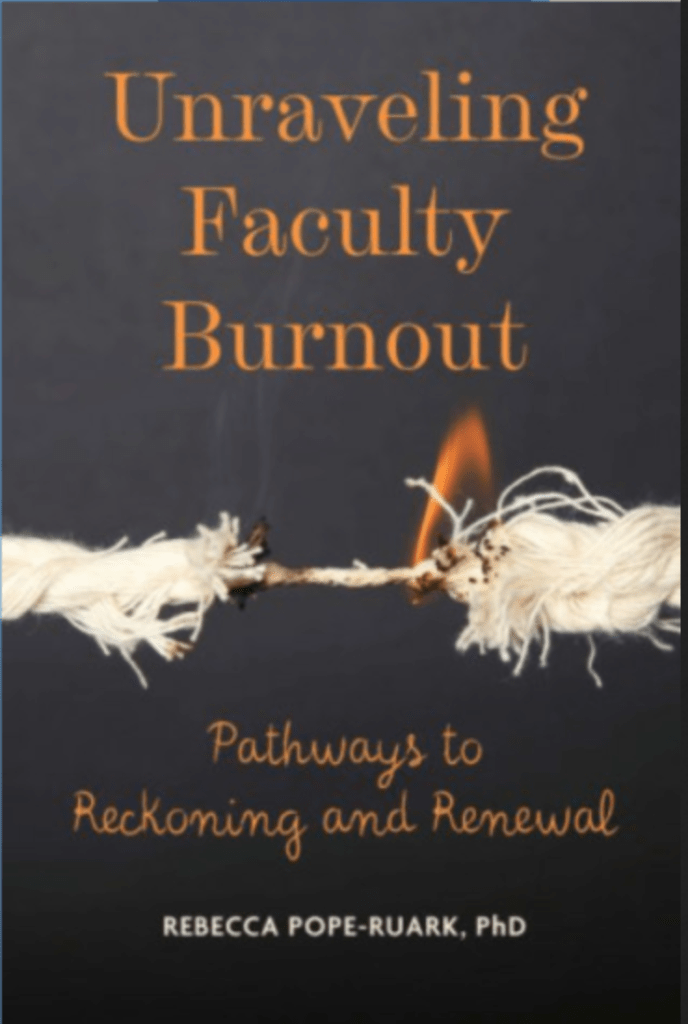
Unraveling Faculty Burnout: Pathways to Reckoning and Renewal
(Johns Hopkins University Press, 2022)
PRESS FOR Unraveling Faculty Burnout
You’ve Burned Out: Now What? Chronicle Review
Author Charts Way Back from Severe Burnout, Inside Higher Ed
Coming Back From Burnout: “Every Academic Has a Story to Tell,” Times Higher Education
As faculty, we talk a lot about how busy we are, overwhelmed, tired, stressed, as if those things are badges in academia. But for many of us, this sense of overwhelm, exhaustion, and cynicism goes far deeper than malaise at the end of a semester or academic year. Just opening up to a few colleagues and posting some preliminary ideas about burnout on Twitter showed me just how many of my peers and colleagues have either themselves experienced burnout or know someone else in higher education who has.
Burnout happens to the best of us. Burnout can also be contagious in a culture that breeds it. But burnout cannot remain hidden and shameful if we openly discuss it. Without language to understand what is happening, faculty experiencing burnout might detach from aspects of their work that used to bring them joy, avoid peers and students to protect themselves emotionally, change jobs, or even leave academia. When this happens, we all suffer that loss.
Burnout, a mental health syndrome caused by chronic workplace stress, is endemic to higher education in a patriarchal, productivity-obsessed culture. In this unique book for women in higher education, Rebecca Pope-Ruark, PhD, draws from her own burnout experience, as well as collected stories of faculty in various roles and career stages, interviews with coaches and educational developers, and extensive secondary research to address and mitigate burnout. Pope-Ruark lays out four pillars of burnout resilience for faculty members: purpose, compassion, connection, and balance. Each chapter contains relatable stories, reflective opportunities and exercises, and advice from women in higher education.
Blending memoir, key research, and reflection opportunities, Pope-Ruark helps faculty not only address burnout personally but also use the tools in this book to eradicate the systemic conditions that cause it in the first place. As burnout becomes more visible, we can destigmatize it by acknowledging that women are not unraveling; instead, women in higher education are reckoning with the productivity cult embedded in our institutions, recognizing how it shapes their understanding and approach to faculty work, and learning how they can remedy it for themselves, their peers, and women faculty in the future.
Contributors: Lee Skallerup Bessette, Cynthia Ganote, Emily O. Gravett, Hillary Hutchinson, Tiffany D. Johnson, Bridget Lepore, Jennifer Marlow, Sharon Michler, Marie Moeller, Valerie Murrenus Pilmaier, Catherine Ross, Kristi Rudenga, Katherine Segal, Kryss Shane, Jennifer Snodgrass, Lindsay Steiner, Kristi Verbeke
Untangling Burnout and Leadership in Higher Ed
in development for Johns Hopkins University Press
Over the past four years, faculty and staff have become more comfortable addressing mental health issues and burnout in higher education, thanks to the vulnerability we all shared during Covid and more institutional attention on student well-being leading to calls for attention to faculty and staff wellness. But leaders and administrators are regularly left out of this compassion and new attention to well-being, often because faculty assume they have chosen their fate and are well-paid for it. Leaders in higher ed face extensive internal and external forces that lead to chronic stress, exhaustion, cynicism, and reduced efficacy – the key characteristics of burnout. Leaders are far from immune to burnout given the high stress environments they work in, but the culture of higher education today allows for no weakness and no mistakes from our leaders. Administrators are often held responsible for the slightest error in judgment, unwelcome moves from a state system or board of governors, or executive decisions no matter how far removed they may be from it. And higher ed itself is facing sea changes thanks to the demographic cliff, generative AI, the war in Gaza, labor and unionization movements, and declining public and political support.
In this follow-up to Unraveling Faculty Burnout and based on over 50 interviews with leader, coaches, and administrators, I explore the internal and external stressors impacting higher ed leaders, share stories from administrators about their burnout and treatment by colleagues, and offer strategies for working through burnout by building trust, serving with compassion, finding your people, and modeling balance. The purpose of the book is to offer meaningful support to higher ed leaders from chairs and directors up through the senior leadership teams who may be experiencing burnout and feel like they have nowhere or no one to turn to by virtue of their role. The book will help leaders feel validated in their feelings, understand burnout better, and learn strategies for addressing it.
 Rebecca Pope-Ruark, Ph.D.